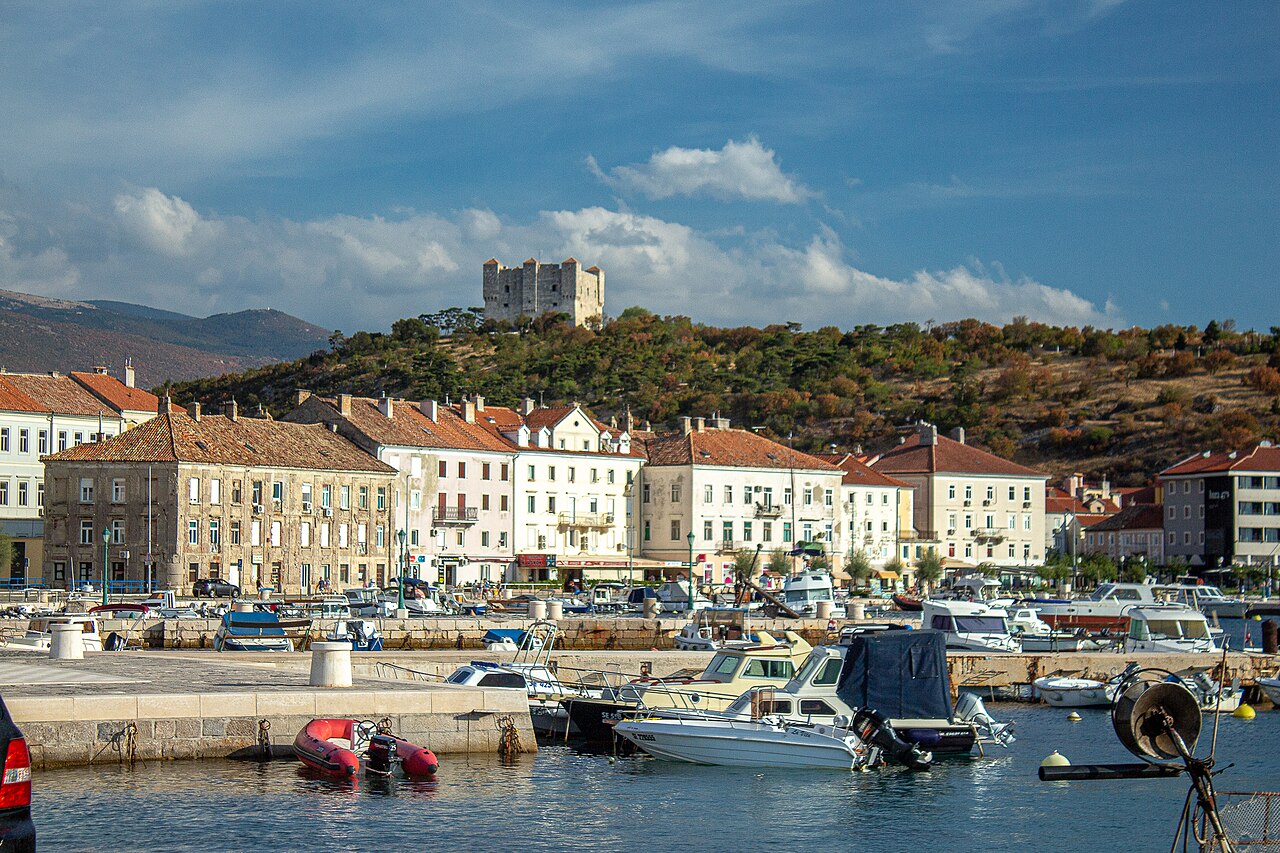
A fortress for a changing frontier
Nehaj was completed in 1558 under the supervision of Ivan Lenković and Herbart VIII Auersperg. Its setting above Senj was not chosen for a picturesque silhouette: this was a position from which approaches to the town could be watched and defended.
The museum’s historical account places the project in an age of increasingly powerful artillery and Ottoman expansion. Seen in that context, the fortress becomes more than a castle-shaped attraction. It is a response to a particular moment in European military history.
An older town, built into the walls
Building material came from churches, monasteries and houses dismantled outside the town’s defensive walls. Look at the masonry as a record of that transformation, rather than as one uniform surface.
Reused worked stone is known as spolia. The term is useful here because it invites a second look: a defensive structure can also preserve fragments of buildings that no longer stand.
The Uskoks, beyond a simple legend
The Senj Uskoks are central to understanding Nehaj. The museum describes how people escaping Ottoman advances became part of the town’s defence and the fortress garrison.
Their story deserves more than a heroic slogan or a costume photograph. Start with the historical context provided by the museum, then notice how much the building itself reveals about shelter, surveillance and life on a frontier.
Why 1558 matters
Nehaj is a 16th-century stronghold, not simply a generic “medieval castle”. The date helps make sense of its compact geometry and its provision for firearms.
Keep that distinction in mind as you explore. A good visit is not about collecting the greatest number of dates; it is about connecting one or two of them to what you can actually see.
A new chapter: the museum
Senj Town Museum manages the fortress. Exhibitions connect the Uskoks and the coastal military captaincy with the city’s churches and heraldic heritage.
The experience continues outside the building. Looking back at Nehaj from the harbour is a useful final step: the fortress and the town begin to read as one landscape.
Sources & further reading
Sources checked · 20 September 2026
Sources checked · 20 September 2026